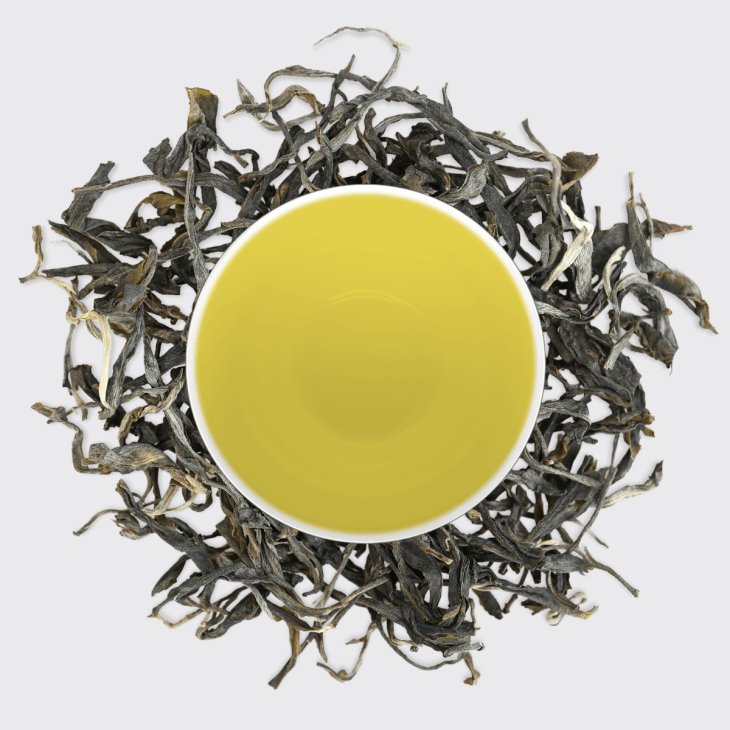




Here is our 2026 selection for Young Gushu, showcasing the perfect terroir of Mei Zi Qing village. Creamy, syrupy, starchy, fruity and floral all in a balanced, elegant brew.
After many rounds of tasting countless Raw PuErh Maocha, this beauty came out on top and was crowned 'Young Gushu'
Our 2026 selection comes from the village of Mei Zi Qing in Yongde, Lincang.
The forests around this village have a whole range of ages of tea trees, and this batch is from 150-200 year old trees growing at altitudes of between 1900 and 2200m.
This tea is LUSH.
It starts with the warmer aromas of candied almonds and the earthy hit of valerian, all sweetened by overripe pears.
Wake the leaves up with a splash of water, and they explode in a syrupy and starchy yet herbal, fruity and floral bouquet that combines disparate notes into a harmonic whole. It is so complementary that the aromatics blur together making iit hard to find individual tasting notes.
But focus the mind, and I start to isolate warm rising dough and raw rice as the starch and creams, starfruits, fruit blossoms, jasmine and linden give the aromatics brightness, and it is all wrapped in soft syrup.
The mouthfeel starts thick but the high saponins in the tea reduce the surface tension to make the tea run and flood every part of your mouth in a sweeping wave, leading to an isotonic quench.
The taste builds from salted maple syrup soaked apricots to creamy nuts, calpis milk soda and the stony minerals of hot summer pavements.
The smell of the empty cup is an apricot tarte-tatin, and the finish is honeyed and floral.
Body sensation on Young Gushu 2026 is a slow burner. At first you don't feel much shift but then these ancient trees start to show their power with an enduring vitality.
Add this to your Young Gushu collection or if you are just starting then, enji the special taste of freshly made ancient tree tea.
What is the Young Gushu series?
It's a homage to the way that farmers drink their PuErh in Yunnan - a loose leaf assamica green tea fresh from sun-drying and straight into the gaiwan. No fuss, no pressing into cakes, no fancy artwork, no ageing. We want you to experience this back-to-basics way of enjoying the finest PuErh. Another advantage is that you get to sip on immaculate PuErh without splurging money on a cake.
Why? Because there is something magical about drinking fresh and loose PuErh. Not only does it bring us back to the perfect simplicity of such a hyped tea type but, if you find the right tea, can give you a very different experience - capturing the verve and vitality of Springtime in Yunnan and the directness of the terroir since the leaf is simply dried under the sun with no further processing.
The problem is that finding candidates for the Young Gushu series is very challenging. We want ancient tea material which has richness, complexity and body. A tea which would be worthy of making into an expensive tea cake and ageing for years. Yet, we also need that tea to have the Springtime lightness and an easy sipping nature which is often hard to come by with fresh assamica maocha (they are often too astringent and 'green' which is reduced with cake-pressing and ageing).
While Young Gushu teas are chosen for drinking fresh, they will continue to age beautifully - they will certainly age differently to cake-pressed teas but in our experience they perform fabulously over the years.