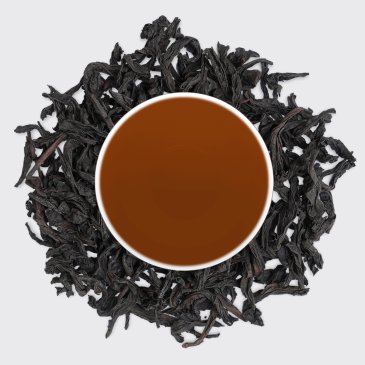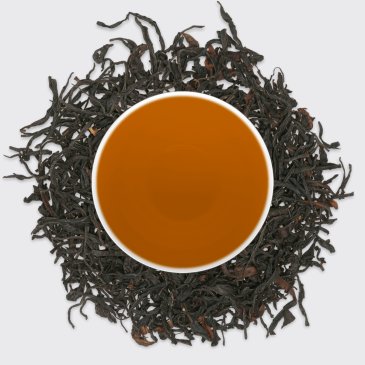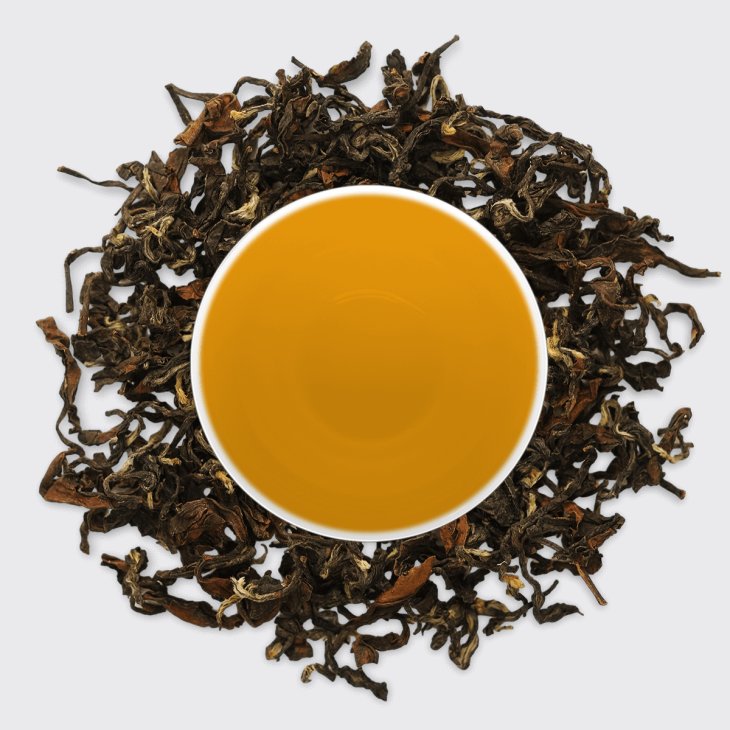



An Oriental Beauty that hits all of the high notes of this famed tea, but with added Yunnan depth and richness. Spices, fruits, flowers, woods and melted butter!
Taiwan's most loved and most expensive Oolong is rightly hailed as one of the great teas in history.
Oriental Beauty is a heavily oxidised Taiwanese Oolong which is very rich in terpenes - volatile aromatics giving the tea a potent fragrance. This amplified level of terpenes is due to the processing of the leaf, but it can be even more complex if the leaf is attacked by the Jassid or Leaf Hopper before picking.
The processing increases the amount of terpenes especially Linalool and Geraniol. These give the tea a floral and fruity fragrance with notes of geranium, rose, citrus, citronella and lychee. If the plantation is visited by the jassids, then the tea plants create another compound called 2,6-dimethyl-3,7-octadien-2,6-diol which is a precursor to Hotrienol. The reason why the tea plant creates this terpene is either because it is a fragrance that the Jassids do not enjoy or because it attracts the natural predators to the Jassids, but whatever the reason, the result is even higher levels of terpenes. Hotrienol is responsible for the fermented, sweet fragrance in Riesling, Gewurztraminer, elderflower, rose and honey.
But much of the Oriental Beauty (especially the competition winning batches) have, in my opinion, placed too mch emphasis on these incredible aromatics. They show off a clarity of these heavenly smells but they taste empty with little complexity in taste and texture.
And so, hunting for these expensive Oolongs has been a big struggle for me for years - I know that I can get 'great' batches that smell incredible and will sell but I can't honestly say that I love the tea and therefore will not purchase.
So in late autumn 2025 I had resigned myself to yet another year without and Oriental Beauty. But then this sample arrived in a random tasting (which I coincidentally filmed)
Yunnan Beauty is an Oriental Beauty style Oolong made in China from the Ruan Zhi Cultivar, which has a bit of mysterious history. This cultivar is likely to have ancestral roots in Fujian Province (China) but was brought over to Taiwan in, most probably, the mid to late 19th Century. In Taiwan, the cultivar was developed and is likely to be the same as TRES #17 called Bai Lu. It is thought that the original Ruan Zhi was hybridised with other varieties to eventually make Qing Xin, one of the most popular cultivars in Taiwan. Some people mistakenly think that Qing Xin and Ruan Zhi are interchangeable.
The Ruan Zhi in Taiwan is most often used to make Oolong tea, and it has since travelled to Northern Thailand and Myanmar in their burgeoning tea industry to produce Oolongs modelled on Taiwanese tea.
I love this cultivar and when used to produce an Oriental Beauty Oolong like this I am swooning.
Yunnan Beauty has all of the gorgeuos candy and muscat top notes of an Oriental Beauty but the fruits and flowers are nestled amongst a whlole landscape of other notes - from spices like saffron and cinnamon to jams and honeys and the deep Yunnan forests.
The texture is thick and smooth and leads to a taste rich in satisfying stone fruit, vinyl, woods and buttery warmth.
This is an Oolong with bags of depth and complexity which, some may find, lacks the clarity and specificty of the expected Orienatl Beauty aromatics. But, to my tastes, this depth makes the tea so much more enjoyable. It transports you and takes you on a journey to source rather than just sniffing the isolated aromas with a clean tasting backdrop.
This, like everything in tea, is a matter for your tastes but I highly encourage you to taste what I consider to be a pinnacle 'Oriental Beauty' (at a fraction of the prices of Taiwan).
Yunnan Beauty is the traditional Oriental Beauty that I remember from decades ago and I am so happy to have found it again. I hope that this style of Oolong continues to build in popularity.